



13 Jul TRUSTS “UNLIMITED” CHARITABLE DEDUCTION
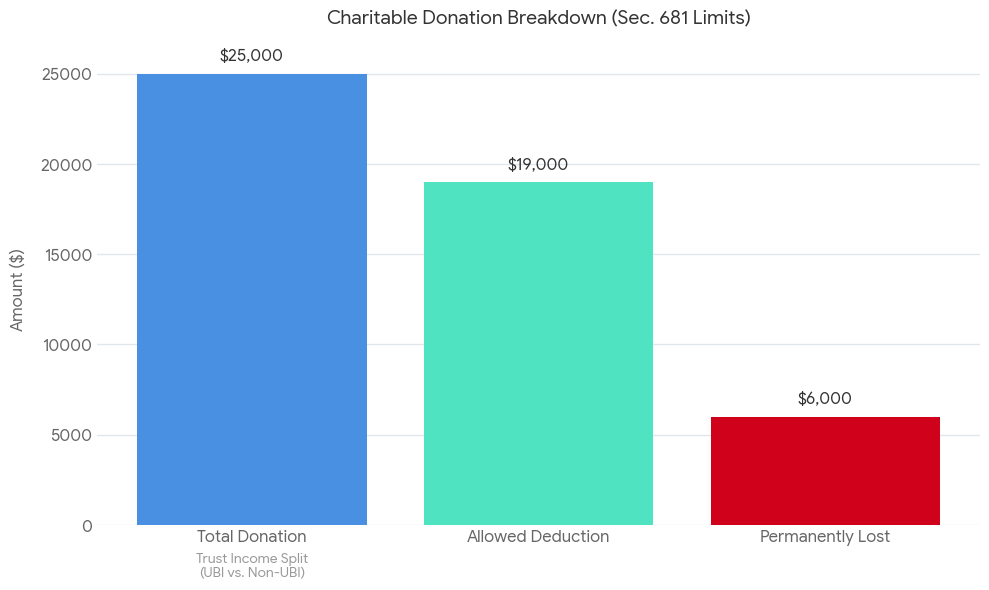 Trusts can take a charitable tax deduction under Section 642(c), often described as “unlimited,” meaning they could potentially reduce taxable income to zero. However, this is not truly unlimited because Section 681 limits the deduction when the trust has unrelated business income (UBI), such as:
- Income from operating businesses
- Income from leveraged investments
Key impact of Section 681 is the portion of charitable donations tied to UBI is subject to the same limits individuals face under Section 170. This reduces how much the trust can deduct.
- Important limitations:
- Part of the deduction may be capped (not fully deductible).
- Any excess deduction is permanently lost (no carryforward).
- Contributions must actually be paid out during the year.
Not all trusts are treated the same:
- Grantor trusts and ESBTs follow individual rules (Section 170), which do allow carryforwards.
- Estates are not subject to Section 681, which can create planning advantages.
Basic calculation process:
- Figure out how much of the trust’s income is UBI.
- Split the charitable donation between UBI and non-UBI income.
- Apply percentage limits only to the UBI portion.
- Simple example:
- A trust earns $50,000 total ($30,000 business income + $20,000 investments).
- It donates $25,000 to charity.
- Because part of the income is UBI:
- Only $19,000 is deductible.
- $6,000 is lost permanently.
- Big takeaway:
- The “unlimited” charitable deduction for trusts can be significantly reduced.
- Careful planning (especially around UBI and estate elections) is important to maximize tax benefits.
If any topics covered in this newsletter raise questions or if there are other accounting or tax matters on your mind, Gates Kirby & Company is always happy to provide guidance tailored to your unique situation. Our team genuinely enjoys helping clients navigate these topics with confidence. We look forward to connecting with you soon.
- Gates, Kirby & Company.
Tax laws, regulations, and interpretations change frequently. Due to nature and complexity of changing tax laws, the content may become outdated and therefore be historical. The newsletters provide no guarantee the information is complete, accurate, or current. Readers should review applicable rules and laws by consulting official sources (e.g., IRS, Colorado Department of Revenue) and/or consult with Gates, Kirby & Company to review how the newsletter content may be applicable to your tax situation.